“Breaking the Relationship Cycle: Understanding Why the Same Emotional Patterns Keep Repeating and How to Change Them”
By Stefan M. Dunn, MSc
You may have asked yourself:
“I tried. I gave everything I had. Why does it always seem to end the same way?”
Maybe the relationship started with chemistry and connection. Then something changed. You argued more, she became distant, and you became defensive. One pursued while the other withdrew. Resentment grew, and conversations became exhausting.
Maybe you were told you were emotionally unavailable, too needy, too sensitive, too distant, too controlling, or too passive. And eventually, you started wondering:
“What is wrong with me?”
I think there’s a better question:
“What happens inside me when I begin to feel emotionally unsafe in a relationship?”
That question can change everything.
Relationships Don’t Just Trigger Arguments. They Trigger Attachment.
From an Emotionally Focused Therapy perspective, intimate relationships activate one of the most powerful systems we have: our attachment system.
We are wired for emotional connection. We want to know: Are you there for me? Do I matter to you? Can I trust you? Will you stay when things get difficult?
When those answers begin to feel uncertain, we protect ourselves. One man pursues while another withdraws. One becomes angry while another shuts down. One tries desperately to fix everything while another convinces himself he doesn’t need anyone.
These behaviours look different, but underneath may be similar emotions: fear, hurt, shame, loneliness, rejection, and helplessness.
The behaviour often isn’t the deepest problem. It’s the protection around it.
The Relationship You’re Having Today May Be Touching Something Much Older
This is where EFIT and attachment-based therapy can become particularly powerful.
Sometimes your reaction to your partner isn’t entirely about what just happened. She criticizes you and something inside you hears:
“You’re not good enough.”
She becomes distant and your emotional system hears:
“You’re going to be abandoned.”
She wants more independence and you hear:
“She doesn’t need me anymore.”
She becomes angry and you immediately shut down because somewhere inside you learned:
Conflict isn’t safe.
These emotional responses often have histories. Maybe growing up, love felt conditional. Maybe mistakes brought criticism. Maybe emotions weren’t discussed in your family. Maybe you learned to keep everyone happy. Maybe a parent was unpredictable, unavailable, controlling, critical, or overwhelmed.
Maybe you became the responsible one, the peacemaker, the achiever, the funny one, or the invisible one.
Those strategies may have protected you when you were younger. But what protected you at twelve can interfere with intimacy at forty.
Therapy isn’t about blaming your childhood. It’s about stopping it from unconsciously running your adult relationships.
When Protection Becomes the Problem
Imagine that underneath your anger is actually fear of losing your partner. But instead of saying:
“I’m scared we’re becoming disconnected, and I don’t know how to reach you,”
you criticize her.
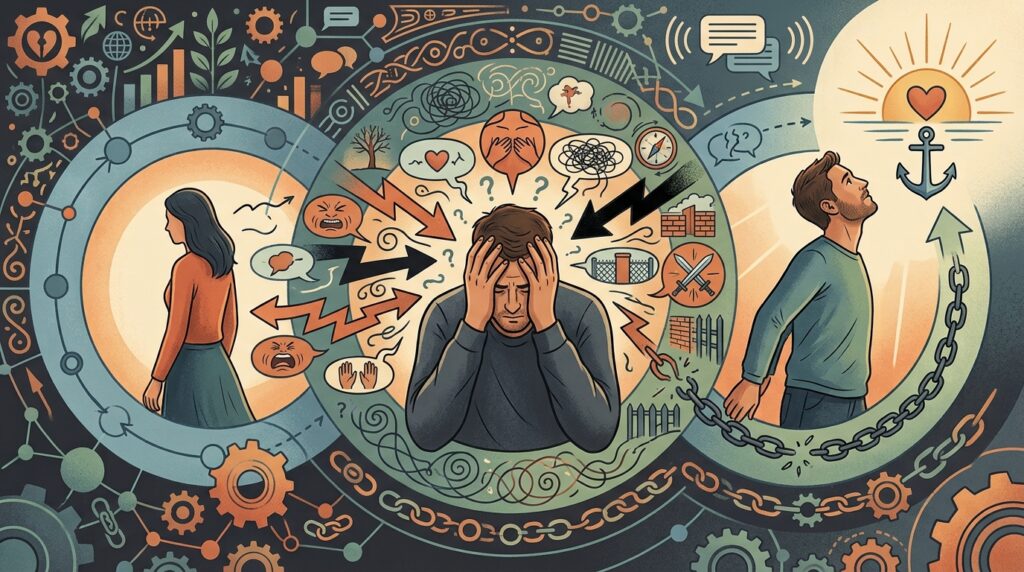
She experiences criticism and becomes defensive. You experience her defensiveness as rejection, so you push harder. She withdraws further.
Now both people believe the other person is the problem.
This is the negative cycle we pay attention to in Emotionally Focused Therapy.
You pursue because she withdraws.
She withdraws because you pursue.
Eventually, you’re no longer fighting about the original issue, but the emotional disconnection underneath it. Both people can end up feeling alone.
Men Often Feel Anger Before They Recognize Hurt
Many men have more practice expressing anger or frustration than sadness, fear, loneliness, or shame. Men still experience those emotions, but years of suppressing vulnerability can limit their emotional vocabulary.
So instead of:
“I’m afraid I’m losing you,”
you say:
“Whatever. Do what you want.”
Instead of:
“That really hurt me,”
you say:
“You’re ridiculous.”
Instead of:
“I don’t feel important to you anymore,”
you shut down.
EFIT helps us slow that process down. What’s underneath the anger? What’s underneath the withdrawal? What’s underneath the need to fix everything?
That’s often where the real therapeutic work begins.
Your Body Usually Knows You’re Triggered Before Your Mind Does
Emotions aren’t experienced only as thoughts. They’re experienced physically. Your chest tightens, your stomach drops, your jaw clenches, your breathing changes, your heart accelerates, and your shoulders tighten. You suddenly feel the need to defend yourself, leave the room, prove your point, or shut down completely.
This is why simply telling couples to “communicate better” isn’t always enough. You can know communication techniques and still lose access to them when your nervous system is overwhelmed.
This is where I integrate DBT-informed emotional regulation, mindfulness, grounding, breathing, and somatic awareness with attachment work.
The goal is to recognize:
“I’m activated right now.”
Then create enough space between the feeling and the reaction to choose what happens next.
That’s emotional regulation. Not suppressing emotion, but learning how to experience emotion without allowing it to control your behaviour.
Challenge the Story Your Mind Creates
CBT adds another important layer.
Your emotional system reacts, and then your mind creates a story explaining what happened.
“She doesn’t respect me.”
“She doesn’t care.”
“She’s going to leave.”
“I can never make her happy.”
“I’m always the problem.”
“I’ll never find anyone else.”
But a thought isn’t automatically a fact.
So we slow down and examine it.
What actually happened?
What am I assuming?
What emotion am I experiencing?
What old belief might this situation be activating?
Is there another possible interpretation?
This means learning to respond to reality rather than automatically responding to fear.
Loyalty Can Become Self-Abandonment
This matters especially for men who pride themselves on loyalty.
You might say:
“I don’t quit.”
“I fight for the people I love.”
“I’m ride or die.”
Loyalty is a strength until maintaining the relationship requires abandoning yourself.
If you’re constantly chasing, fixing, apologizing, tolerating disrespect, ignoring your boundaries, or trying to convince someone to choose you, ask yourself:
“Am I fighting for this relationship, or am I afraid of what it means if I let it go?”
Healthy relationships require two people. You cannot create mutuality alone.
And boundaries aren’t punishment.
A healthy boundary says:
“I can love you without abandoning myself.”
Stop Falling in Love With Potential
Another painful pattern is staying attached to someone’s potential.
You remember the beginning. You remember the incredible weekend. You remember the promises. You remember who she was when things felt good. And you keep waiting for that relationship to return.
So ask yourself:
“If absolutely nothing changed and this relationship remained exactly as it is today for the next five years, would I choose it?”
Don’t answer based on potential. Answer based on reality.
That’s not pessimism. That’s emotional clarity.
Rebuilding Self-Trust After Ignoring Red Flags
After an unhealthy relationship ends, men often turn against themselves.
“How didn’t I see this?”
“Why did I believe her?”
“Why did I stay?”
“How can I trust myself again?”
Self-criticism won’t rebuild self-trust. Curiosity will.
Instead of asking:
“How could I have been so stupid?”
ask:
“What was I feeling that I repeatedly talked myself out of?”
Maybe you felt uncomfortable. Maybe something didn’t add up. Maybe you felt anxious, inadequate, controlled, lonely, or confused. But perhaps you feared losing the relationship more than you trusted the discomfort.
Rebuilding self-trust isn’t about never making another relational mistake. It means trusting that:
“When something consistently violates my values, boundaries, or emotional wellbeing, I will listen to myself and respond.”
The Good Memories Don’t Have to Become Bad
After betrayal or a painful breakup, people sometimes ask:
“Was any of it real?”
It doesn’t always have to be one extreme or the other. There may have been genuine love and beautiful memories alongside unhealthy dynamics.
Both can be true.
Healing doesn’t require rewriting the relationship as terrible. It means seeing both the good and the bad clearly.
What Healthy Masculinity Can Look Like in Relationships
Being emotionally available doesn’t mean becoming passive. Being vulnerable doesn’t mean surrendering your boundaries. And strength doesn’t require emotional shutdown.
Healthy emotional strength can mean being able to say:
“That hurt me.”
“I’m angry, but I’m not going to attack you.”
“I love you, and this behaviour isn’t acceptable to me.”
“I’m afraid of losing you, but I’m not going to abandon myself to keep you.”
“I was wrong.”
“I need something from you.”
“This relationship isn’t healthy for me anymore.”
That combination, vulnerability with boundaries, is something many men were never taught.
Breaking the Cycle
Therapy isn’t about never being triggered. It’s about recognizing what happens when you are.
Through EFIT and attachment-based work, we identify the deeper emotions and attachment injuries driving the pattern. Through CBT, we challenge the beliefs and interpretations keeping that pattern alive. Through DBT-informed skills, mindfulness, and somatic regulation, we learn how to stay emotionally regulated enough to make different choices.
Through self-compassion, we stop treating shame as a strategy for personal growth. And through communication and boundary work, we learn how to bring those internal changes into actual relationships.
Eventually, instead of automatically asking:
“How do I keep her?”
you begin asking:
“Who am I becoming in this relationship?”
“Can we be vulnerable with each other?”
“Can we repair after conflict?”
“Can I express my needs without attacking or disappearing?”
“Are my boundaries respected?”
“Are we both doing the work?”
“Can I be myself here?”
Those are very different questions.
You Don’t Need to Master Love. You Need to Understand Your Pattern.
Most relationship patterns make sense when we understand where they came from. That doesn’t excuse harmful behaviour.
Understanding creates responsibility.
Once you recognize your pattern, you can interrupt it. You don’t have to keep chasing people who withdraw. You don’t have to withdraw whenever someone gets close. You don’t have to earn love through people-pleasing. You don’t have to fix everyone. You don’t have to confuse intensity with intimacy. And you don’t have to abandon yourself simply because you love someone.
The goal isn’t perfection. It’s becoming aware enough to recognize your patterns, regulated enough to interrupt them, and secure enough to choose differently.
You can be strong and vulnerable.
You can love deeply and have boundaries.
You can fight for a relationship without fighting alone.
And sometimes the most important relationship work you’ll ever do begins before your next relationship, with understanding the emotional patterns you bring into it.
Ready to Break the Pattern?
If you recognize yourself in these cycles, whether you’re struggling in your current relationship, recovering from betrayal or a breakup, or wondering why you keep finding yourself in the same kind of relationship, this is work we can do together.
In a one-on-one therapy session, we’ll look beyond the surface problem and begin identifying the attachment patterns, emotional triggers, core beliefs, and protective behaviours that may be shaping your relationships.
The goal isn’t to tell you to stay or leave. It’s to help you understand yourself well enough that your next decision comes from clarity rather than fear, attachment, guilt, or old emotional wounds.
Book a one-on-one session with me and let’s start breaking the cycle.
By Stefan Morgan Dunn, MSc