
Why “Emotional Unavailability” Feels Like a Life Sentence for Men
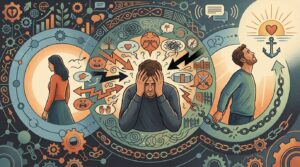
Hearing your partner say you’re “emotionally unavailable” can hit hard, like a judgment, a rejection, or a label you don’t know how to shake. It feels like being accused of a crime you don’t fully understand.
But what does “emotional unavailability” really mean for men?
From a behavioralist lens, it often reflects a pattern of learned avoidance, maybe growing up, emotions were dangerous or punished. Maybe vulnerability was equated with weakness. You adapted by closing off, not because you don’t care, but because it felt safer.
Evolutionary psychology shows us that men’s brains, wired to protect and provide, often prioritize action over emotional expression. Your nervous system is primed to solve problems, fix, or defend, not necessarily to process feelings the way your partner wants.
Add social psychology to the mix: men face pressure to be stoic, independent, and “strong.” Expressing emotion can be misunderstood as needing or weakness, so many men build an emotional firewall just to survive.
But here’s the catch: what’s labeled “unavailable” might actually be a mismatch in emotional language and expectations. Your partner might want connection through sharing feelings, while you might show care through actions, silence, or problem-solving. The gap between these two styles gets mistaken for coldness or disinterest.
In the mental health industry, this label is often slapped on men without digging deeper. It can lead to shame, frustration, or a feeling that you’re broken, instead of seeing it as a learned behavior with specific roots that can be healed.
Therapy Strategies to Build Emotional Availability
Emotional availability isn’t a switch you flip overnight, it’s a muscle you develop with intentional work. Here are therapy approaches that can help:
Attachment Repair & Emotional Coaching
We explore your early emotional experiences and attachment style to understand where emotional walls came from. Then, with guided practice, you learn to safely express vulnerability, starting small and building trust in the process.
Mindfulness & Body Awareness (Somatic Therapy)
Many men disconnect from emotions because they haven’t learned to feel bodily sensations or recognize internal states. Through mindfulness and somatic exercises, you learn to identify what you’re feeling before it becomes overwhelming or hidden behind anger, shutdown, or distraction.
Communication Skills & Emotional Literacy
You get tools to express emotions in ways your partner can hear, moving beyond “I’m fine” or silence. This includes naming emotions, sharing needs clearly, and learning to listen without fixing or shutting down.
Cognitive Restructuring (CBT)
You challenge internal beliefs like “Showing feelings is weakness” or “I’ll lose control if I open up.” Reframing these thoughts helps break the cycle of emotional withdrawal.
Safe Experiential Exercises
Therapy provides a controlled environment where you can practice emotional openness without fear of judgment or rejection, something many men never get outside therapy.
The Payoff: What You Gain When You Become Emotionally Available
In love, emotional availability builds deeper intimacy, trust, and connection. You become the partner who can be both strong and open, who comforts and is comforted. This creates a relationship that feels safe for both you and her.
In life, you’ll notice less inner conflict and frustration. You stop feeling like you’re living behind a mask or carrying emotional baggage alone. You gain a clearer sense of self and emotional balance.
In mental health, being emotionally available reduces stress, anxiety, and feelings of isolation. You build resilience and emotional agility to handle life’s ups and downs.
In wealth and leadership, emotional intelligence is a game-changer. Being able to connect authentically, manage your feelings, and understand others makes you a better leader, decision-maker, and communicator.
Emotional availability isn’t about abandoning strength, it’s about expanding it. It’s the difference between surviving relationships and thriving in them.